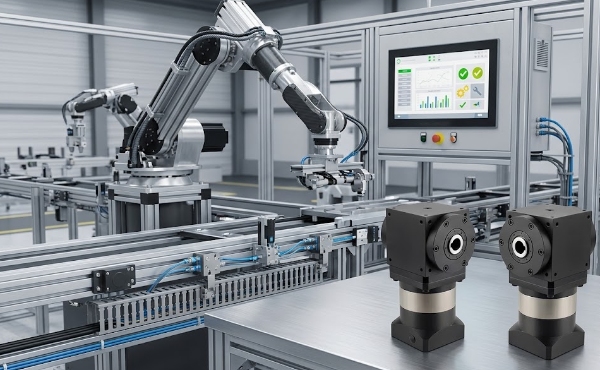
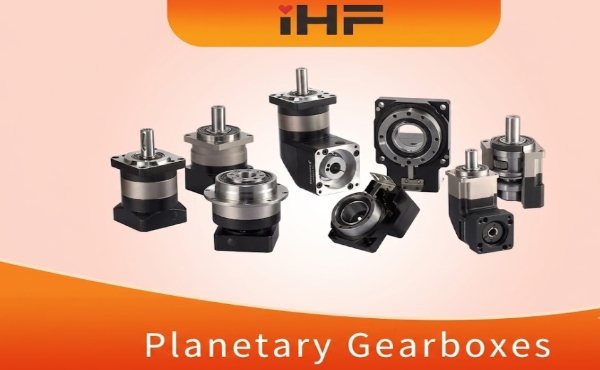
Walk through any modern factory floor, hospital imaging suite, or print production facility, and you will see machines that appear almost effortless. A printing press runs at speed with perfect registration. A medical scanner positions its detector with micron-level repeatability. A laser system cuts intricate geometry without hesitation. An automated line cycles continuously with minimal intervention. Behind each of these machines sits a design decision that rarely makes the headline: the choice of planetary gearbox.
As a manufacturer specializing in planetary gearboxes for printing, medical, laser, and automation equipment, we have learned that this decision shapes everything downstream—accuracy, throughput, service life, and ultimately the reputation of the machine itself.
The Right Architecture for the Job
Planetary gearboxes earn their place through a combination of qualities that few other transmission types can match at once. Multiple planet gears share the load simultaneously, giving high torque density in a compact, coaxial package. The symmetric arrangement balances radial forces, reducing bearing stress and vibration. And the inline layout simplifies integration into machines where space is at a premium.
For printing equipment, this means smooth, quiet rotation at speed. For medical devices, it means compact, reliable motion with low acoustic signature. For laser systems, it means responsive, accurate positioning. For automation, it means durable, repeatable cycling. The architecture is versatile, but the execution is what separates a good gearbox from a great one.

Precision That Holds, Not Just Precision on Paper
Backlash is the first specification most engineers check, and for good reason. In printing, it appears as registration error and inconsistent dot placement. In laser processing, it becomes path deviation and rough edges. In medical positioning, it erodes repeatability. In automation, it accumulates into positioning error over thousands of cycles.
We control backlash at the source through precision gear grinding, carefully managed tooth flank geometry, and disciplined assembly tolerances—achieving arcminute-level backlash with gear accuracy of ISO 4 grade or better. Just as important, we maintain that precision consistently across every unit we ship. A low-backlash specification is only meaningful if it holds true in unit one thousand as well as unit one.
Stiffness Matters When the Machine Is Moving
Precision at rest is not the challenge. Precision during acceleration, deceleration, reversing, and shock loading is where gearbox quality shows. A transmission with insufficient torsional rigidity behaves like a spring—it winds up under load and releases energy unpredictably, producing overshoot and settling time that no control loop can fully correct.Our gearboxes are engineered for rigidity. Reinforced planet carriers, optimized bearing arrangements, and rigid output interfaces raise torsional stiffness and increase radial and axial load capacity. In high-speed paper feed, rapid laser scanning, and high-cycle automation, this translates into shorter response times, cleaner trajectories, and quieter operation. The machine follows its commanded path without hesitation.
Efficiency, Heat, and Long-Term Reliability
Single-stage transmission efficiency above 95% is more than a catalog figure. It means less energy lost as heat, lower temperature rise, and longer lubricant life. In medical equipment, where thermal stability can affect measurement accuracy, low heat generation is a design requirement. In automation, efficiency compounds across thousands of operating hours into measurable energy savings and reduced maintenance burden.
Long-life lubrication and robust sealing—up to IP65 where needed—keep performance stable in dusty printing environments and cleaning-intensive medical settings alike. Heavy-duty variants further strengthen bearing and sealing configurations for high-load duties, ensuring consistent performance over long-term operation.

Configured Around Your Application
No two applications ask the same questions. Printing equipment prioritizes smooth, quiet, high-speed rotation. Medical devices demand reliability, cleanliness, and minimal acoustic noise. Laser systems need dynamic responsiveness and positioning accuracy. Automation calls for durability and flexible integration. Our portfolio—standard precision series, right-angle configurations for constrained spaces, and heavy-duty models for high-load duties—is organized around these differences, and our engineering team works with customers to match ratio, backlash class, and mechanical interface to the actual motion profile.
The Component That Earns Its Place
A planetary gearbox will never be the headline feature of a machine. But when it is engineered well, it disappears into the background—no vibration, no drift, no maintenance interruptions, no unexplained errors. That disappearance is the highest compliment a transmission component can receive.
We build planetary gearboxes for machines that demand exactly that: printing equipment that reproduces perfectly, medical devices that clinicians can trust, laser systems that cut and mark with confidence, and automation that runs without drama. The motion may be invisible. The engineering behind it is not.


 EN
 en
 vi
 it
 es
 th
 tr
 ja
 pt
 ko
 ru
 fr
 de
 ar
 Request Quote