Position: Home > News Center > Industry News > Servo Motor Integration Made Simple: A Practical Guide to Newgear Right Angle Servo Gearbox Mounting and Configuration
Servo Motor Integration Made Simple: A Practical Guide to Newgear Right Angle Servo Gearbox Mounting and Configuration
Jun. 30, 2026 Views:237
In today’s automation landscape, machine designers face a persistent paradox: increasing torque density and sub-arcminute positioning accuracy are required, while machine footprints continue to shrink. Inline planetary gearboxes, though widely used in coaxial configurations, often force mechanical compromises such as extended machine frames, inefficient drivetrain routing, or suboptimal motor orientations.
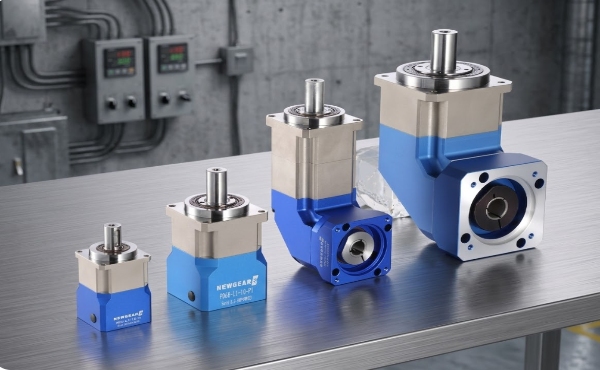
This is where the Newgear Right Angle Servo Gearbox provides a strategic alternative. By redirecting the drive axis by 90 degrees, it enables compact mechanical architectures without sacrificing servo-level precision. At iHF Group, demand for right-angle configurations has increased significantly, especially from semiconductor equipment, medical automation, and collaborative robotics, where space efficiency directly impacts system cost and performance.
Mechanical Architecture: Hypoid vs. Bevel vs. Worm
Not all right-angle servo gearboxes deliver equal performance. The Newgear portfolio primarily uses hypoid and precision bevel technologies, each with distinct trade-offs.
Hypoid Gearboxes
Hypoid designs use spiral-cut bevel gearing with an offset axis, enabling higher reduction ratios in compact form factors. They offer low backlash, smooth torque transmission, and superior load capacity compared to standard bevel systems. The offset also allows larger bearing integration, improving radial and axial load handling—especially important in belt-driven or rack-and-pinion systems.
Bevel Gearboxes
Bevel gearboxes use intersecting shafts and come in straight, helical, and spiral-cut variants. Helical and spiral designs provide smoother engagement and higher efficiency. They are cost-effective but generally exhibit lower stiffness and efficiency compared to hypoid or planetary systems due to higher bearing loads.
Worm Gearboxes
While capable of high single-stage reduction, worm systems suffer from low efficiency and limited backdrivability, making them unsuitable for most servo-grade applications requiring precision motion control.
As a result, modern servo applications primarily rely on hypoid and precision bevel solutions.
Key Performance Metrics
When selecting a right-angle servo gearbox, four parameters are critical:
1. Backlash (Arcminutes)
Backlash directly affects positioning accuracy in closed-loop systems. High-performance hypoid gearboxes achieve ≤1.3 arcmin, while precision bevel systems range between ≤2–4 arcmin. This level supports CNC and semiconductor-grade motion control.
2. Torsional Stiffness
Higher stiffness reduces elastic deformation under load, improving settling time and contour accuracy in multi-axis systems. Integrated housing ring gears and heavy-duty bearings significantly enhance rigidity.
3. Output Torque (Nominal vs Peak)
Nominal torque defines continuous operation capability, while peak torque supports short dynamic events. Typical ranges span 20 Nm to 10,450 Nm, with peak capacity reaching 200–300% of nominal torque.
4. Input Speed Capability
Modern servo motors operate at 3,000–6,000 RPM, with high-speed variants reaching 18,000 RPM. Gearboxes must sustain these speeds without thermal degradation or lubrication breakdown.
Integration Advantages of Right-Angle Design
The 90-degree configuration provides several system-level advantages beyond space savings:
◇ Cable Routing Efficiency
Motor orientation flexibility reduces cable strain and improves system reliability by minimizing flex fatigue.
◇ Hollow Shaft Integration
Many designs support through-bore routing for cables, pneumatic lines, or optical fibers, eliminating slip rings in rotary systems.
◇ Inertia Reduction
Gear reduction decreases reflected inertia by the square of the ratio. A 10:1 system reduces inertia by 100×, enabling smaller motors to drive larger loads efficiently.
◇ Mounting Flexibility
Standard flange compatibility (NEMA and metric formats) allows direct motor integration without custom adapters.
Application Engineering
Different industries require tailored gearbox characteristics:
◆ CNC Machine Tools
Require thermal stability and sustained accuracy. Low-friction bearings and optimized heat dissipation are critical.
◆ Collaborative Robots (Cobots)
Require low weight and inertia with ultra-low backlash to ensure safe human-robot interaction and accurate teach-mode positioning.
◆ Packaging Equipment
Demand high-cycle durability under repeated start-stop loads, requiring fatigue-resistant bearings and stable lubrication systems.
◆ Medical Device Manufacturing
Requires cleanroom compatibility, low particulate generation, and sealed-for-life lubrication systems to prevent contamination.
Engineering Perspective from iHF Group
At iHF Group, gearbox selection is treated as an application engineering process rather than a catalog decision. Demand for servo precision gear systems continues to grow as industries transition from hydraulic and pneumatic systems to fully electric servo architectures.
The global precision gearbox market is projected to reach USD 6.0 billion by 2026, with servo-grade systems accounting for nearly half of total demand. To support OEMs, iHF Group provides full engineering support including torque-speed modeling, CAD integration, and inertia matching analysis to ensure optimal motor-gearbox pairing.
Supply chain resilience is also critical. Variability in alloy steel sourcing and precision machining capacity has made localized quality control and manufacturing consistency a strategic priority.
Maintenance and Lifecycle Performance
High-quality right-angle servo gearboxes are designed for maintenance-free operation, with sealed lubrication systems rated for 20,000+ operating hours.
However, thermal monitoring remains important. Excessive temperature rise often indicates overload or misalignment. Vibration analysis is recommended for predictive maintenance, where changes in acoustic frequency patterns can indicate bearing or gear wear.
Baseline vibration signatures should be recorded during commissioning for long-term comparison.
视频
High-Density FAQ
Q: Why choose a hypoid right-angle gearbox over a traditional worm drive?
A: Hypoid gears rely on rolling friction, maintaining 90-96% efficiency and low backlash. Worm drives rely on sliding friction, dropping efficiency to 60-75% and generating high thermal loads unsuitable for precise servo indexing.
Q: Can these gearboxes be mounted in any orientation?
A: Yes. Most units support horizontal, vertical, or inverted mounting. However, specific grease fill levels must be verified based on the chosen orientation to ensure continuous gear mesh lubrication.
Q: How does efficiency compare to inline planetary designs?
A: Right-angle configurations carry a minor 2-5% efficiency penalty due to bevel-stage directional losses. However, this is heavily outweighed by the footprint reductions and mechanical routing advantages gained.
This website uses cookies to provide you with a safer and more personal experience. By accepting, you agree to the Cookie Policy and the use of cookies for advertising and analytics purposes.


 EN
EN en
en vi
vi it
it es
es th
th tr
tr ja
ja pt
pt ko
ko ru
ru fr
fr de
de ar
ar Request Quote