

 EN
EN en
en vi
vi it
it es
es th
th tr
tr ja
ja pt
pt ko
ko ru
ru fr
fr de
de ar
ar Request Quote
Product Center
Contact Us


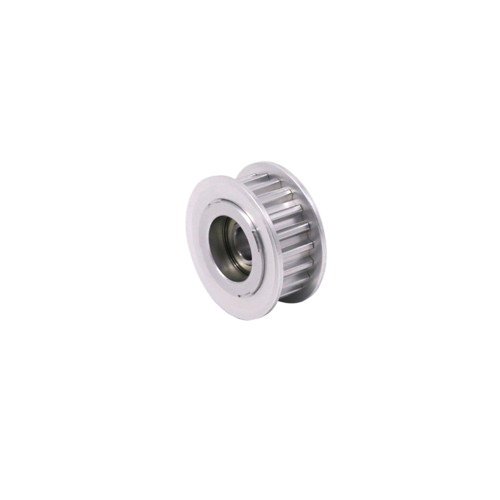
In mechanical drive systems, pulleys and idlers are often used in conjunction with flat belts, round belts, and similar components to perform functions such as power transmission, output guidance, path transition, and belt tensioning. When used specifically for tensioning purposes, they are commonly referred to as tensioner pulleys.
From a structural and functional perspective, pulleys are typically fixed to the drive shaft via keyways or screws, rotating synchronously with the shaft to primarily facilitate power output and transmission. Idlers, on the other hand, are mounted on shafts via bearings, allowing free rotation without transmitting active torque. They are mainly used for guiding, directional changing, increasing the wrap angle, or tensioning belts on the driven side.
Our company primarily supplies flat belt pulleys, toothed idlers, and smooth idlers, which can meet various transmission layouts and operational requirements. Their application scenarios broadly cover the following fields:
· Food Packaging and Pharmaceutical Machinery: Suitable for conveying and sorting systems that require high cleanliness, frequent cleaning, and stable operation.
· Electronic Assembly and Semiconductor Equipment: Used in conveying and positioning mechanisms that demand low vibration and high positioning accuracy.
· Office Automation Equipment: Such as internal drives in printers and scanners, which require quiet, smooth, and long-lasting operation.
· Logistics Conveying and Light Industrial Assembly Lines: Support medium- to high-speed continuous operation with flexible layouts and long maintenance intervals.
· Textile and Printing Machinery: Provide guiding and stabilization in web material handling where precise tension control is critical.
These products are particularly suitable for automated applications in clean environments with high operating speeds and where frequent shutdowns for maintenance are impractical. They effectively enhance the overall reliability and service life of the transmission system.
Online Message
-
*
-
-
-
This is an advertising space
Newgear Intelligent Transmission (Guangdong) Co., Ltd., a high-tech enterprise specializing in precision transmission


