Every precision machine tells two stories. The first is the one users see—the crisp printed page, the clear medical image, the clean laser cut, the smoothly operating production line. The second is the one engineers know—the story of motion controlled so precisely that it becomes invisible. Planetary gearboxes belong to that second story. They are the components that convert a motor's raw speed into deliberate, repeatable movement, and in printing, medical, laser, and automation equipment, that conversion is where quality is quietly decided.
As a manufacturer focused exclusively on planetary gearbox technology, we design and build the parts that make that invisible story possible.
A Simple Principle, Demanding Execution
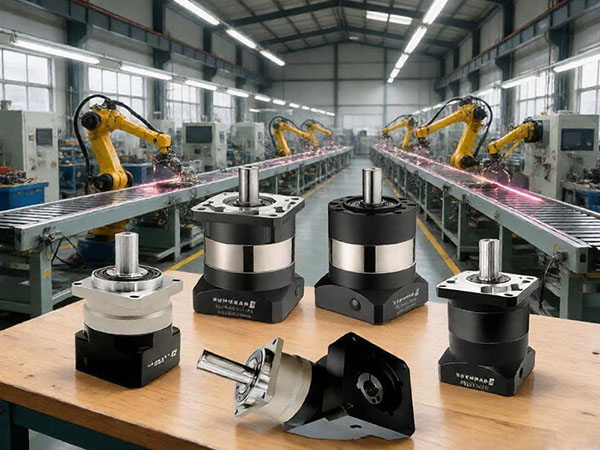
The planetary gearbox's principle is elegant: a sun gear at the center drives multiple planet gears that mesh with an outer ring gear while rotating around the sun, carried by a planet carrier that delivers the output. Because load is shared among several planet gears at once, torque capacity is high relative to size, and the coaxial layout keeps the package compact. Radial forces balance naturally, which means smoother rotation and less vibration.
But elegance in principle does not guarantee excellence in practice. The difference between an ordinary planetary gearbox and a precision one lies in tooth flank geometry, heat treatment, grinding accuracy, bearing selection, carrier stiffness, and assembly discipline. These are the details we obsess over, because they are exactly the details that determine whether a machine holds its accuracy on day one thousand.
Backlash: The Number That Defines Precision
Ask any designer of printing or laser equipment about backlash, and you will get a knowing nod. Backlash—the small rotational play between input and output—shows up as registration error in print, path deviation in laser processing, and lost repeatability in medical positioning. Reducing it requires precision grinding, tight tolerances, and careful preload design.
Our gearboxes achieve arcminute-level backlash, with gear accuracy of ISO 4 grade or better. More importantly, we hold that precision consistently across production, because a specification that varies from unit to unit is not really a specification. For multi-axis equipment where phase alignment matters, this consistency is what keeps every axis synchronized over millions of cycles.
Stiffness: Precision Under Load
Precision at zero load is easy. Precision while accelerating, reversing, and absorbing shock is the real test. A gearbox with low torsional rigidity behaves like a spring—it deflects under load and releases energy unpredictably, producing overshoot and settling time that no controller can fully correct.
We build for stiffness. Reinforced planet carriers, optimized bearing arrangements, and rigid output interfaces raise torsional rigidity and increase radial and axial load capacity. In high-speed printing, rapid laser scanning, and high-cycle automation, that stiffness shortens response time and reduces trajectory error. The machine follows its command path cleanly, cycle after cycle.
Efficiency and Thermal Behavior
Single-stage efficiency above 95% is a headline figure, but its consequences matter more than the number. Lower losses mean less heat, and less heat means greater thermal stability—critical in medical devices where temperature can influence measurement, and valuable in automation where continuous operation demands long lubricant life and infrequent maintenance. Combined with robust sealing up to IP65, our gearboxes hold their performance in dusty printing environments and cleaning-intensive medical settings alike.
Configured for the Application
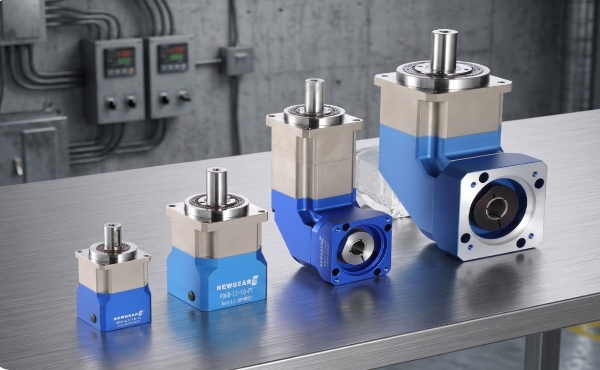
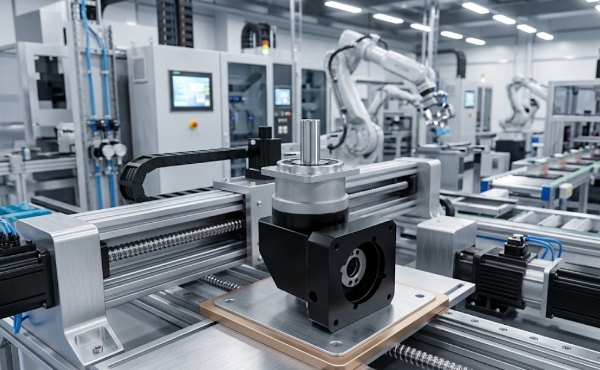
Printing equipment values smooth, quiet, high-speed rotation. Medical devices demand reliability, low acoustic noise, and thermal stability. Laser systems require dynamic responsiveness and positioning accuracy. Automation prioritizes durability and flexible integration. Rather than offering a single compromise design, we maintain a portfolio—standard precision series, right-angle variants for space-constrained installations, and heavy-duty models for high-load duties—and we work with customers to match ratio, backlash class, and mechanical interface to the actual motion profile.
The Value of Getting the Details Right
A planetary gearbox will never be the headline feature of a machine. But when it is engineered well, it disappears into the background—no vibration, no drift, no maintenance interruptions, no unexplained errors. That disappearance is the highest compliment a transmission component can receive.
We build planetary gearboxes for the machines that demand exactly that: printing equipment that reproduces perfectly, medical devices that clinicians can trust, laser systems that cut and mark with confidence, and automation that runs without drama. The motion may be invisible. The engineering behind it is not.


 EN
 en
 vi
 it
 es
 th
 tr
 ja
 pt
 ko
 ru
 fr
 de
 ar
 Request Quote