As industries move toward miniaturization, higher precision, and smarter automation, the demand for compact motion systems has grown dramatically. In fields such as semiconductor manufacturing, medical equipment, precision optics, and robotics, even the smallest mechanical components must deliver exceptional accuracy and stability.
One critical component enabling this technological shift is the Miniature Ball Linear Guide. Despite its small size, this advanced motion system provides smooth linear movement, high load capacity, and micron-level positioning accuracy.
Manufacturers such as iHF Group specialize in developing miniature linear motion solutions designed for high-performance applications where both space efficiency and mechanical precision are essential.
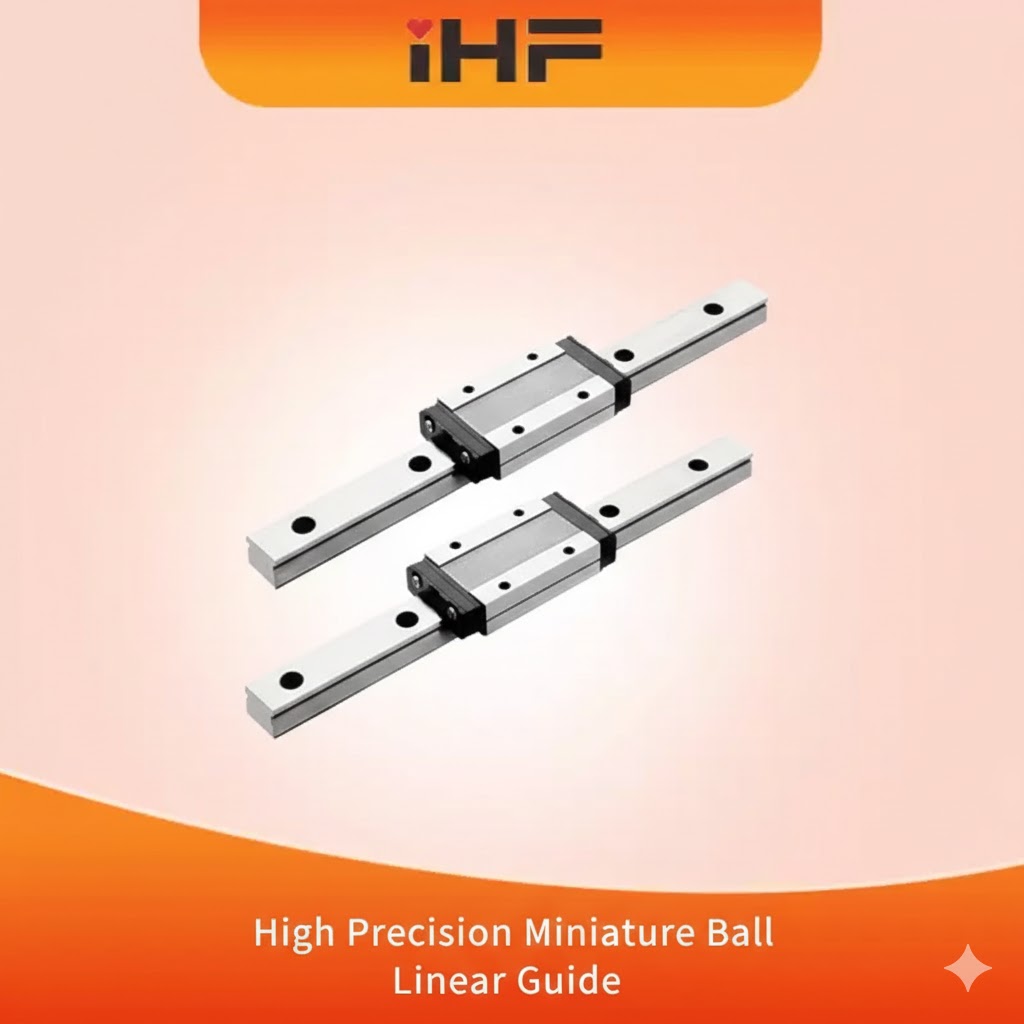
What Is a Miniature Ball Linear Guide?
A Miniature Ball Linear Guide is a precision mechanical component designed to support smooth, low-friction linear motion along a rail system. It consists primarily of:
Precision ground guide rails
Compact slider blocks (carriages)
Recirculating steel balls
Ball return mechanisms
Sealing and lubrication systems
Unlike traditional sliding mechanisms, the recirculating ball design reduces friction significantly while maintaining high rigidity.
The rolling motion of the balls between the rail and carriage allows the system to achieve:
These characteristics make miniature linear guides indispensable in high-precision engineering.
Key Engineering Advantages of Miniature Ball Linear Guides
Miniature guides are engineered specifically for applications where space constraints and accuracy requirements intersect.
Ultra-Compact Structural Design
Miniature linear guides are designed with extremely small cross-sectional dimensions while maintaining structural strength. This enables installation in equipment with limited mechanical space.
For example:
Through advanced manufacturing processes, iHF Group ensures that even ultra-small guide rails maintain consistent dimensional tolerances and mechanical stability.
High Precision and Repeatability
Precision motion systems rely heavily on repeatability and positioning accuracy.
Miniature ball linear guides typically achieve:
Micron-level positioning accuracy
Smooth motion with minimal vibration
Excellent repeatability in repetitive movements
These properties are essential in high-speed automation and micro-positioning systems where errors of even a few microns can affect performance.
Low Friction and High Efficiency
The rolling contact between balls and raceways significantly reduces friction compared to sliding mechanisms.
Benefits include:
As a result, miniature ball linear guides help increase overall system efficiency while extending the lifespan of connected mechanical components.
Structural Components and Technical Design
A typical Miniature Ball Linear Guide includes several precision-engineered elements.
Guide Rail
The guide rail is manufactured using hardened steel and precision grinding processes to ensure straightness and dimensional stability.
Key characteristics include:
High hardness for wear resistance
Precision-machined raceways
Stable geometric accuracy
Slider (Carriage)
The carriage houses the recirculating balls and moves along the rail.
Important design features include:
The carriage design directly influences the guide’s load capacity and motion smoothness.
Ball Circulation System
Inside the slider, balls circulate continuously through a closed-loop path.
This recirculation mechanism enables:
Advanced manufacturing expertise, such as that applied by iHF Group, ensures reliable ball circulation even in extremely compact designs.
Typical Application Fields
Miniature ball linear guides are widely used in industries where precision motion control and compact design are required.
Semiconductor Equipment
Semiconductor manufacturing equipment demands extremely precise positioning. Miniature linear guides support wafer handling systems and micro-positioning modules.
Medical and Laboratory Devices
Medical equipment such as diagnostic instruments and laboratory automation systems require stable and precise mechanical motion within compact structures.
Optical and Imaging Systems
Precision optics systems rely on miniature motion components to adjust lenses, mirrors, and sensors.
Robotics and Automation
In small-scale robotic systems and collaborative robots, miniature guides provide reliable motion control for end-effectors and precision mechanisms.
Key Factors When Selecting a Miniature Ball Linear Guide
Engineers must consider several technical factors when selecting a miniature linear guide.
Load Capacity
Even small guide systems must support dynamic loads during operation. Engineers must evaluate both static and dynamic load ratings.
Precision Grade
Miniature guides are typically available in several accuracy grades depending on application requirements.
Material and Surface Treatment
Anti-corrosion coatings or stainless steel variants may be necessary in humid or chemically aggressive environments.
Lubrication System
Proper lubrication ensures long-term performance and minimizes wear in high-frequency motion applications.
By providing multiple configurations and customization options, iHF Group supports diverse engineering requirements across industries.
Conclusion
The Miniature Ball Linear Guide plays a vital role in modern precision engineering. Its compact structure, smooth motion characteristics, and high accuracy make it indispensable in industries ranging from semiconductor manufacturing to medical technology.
As automation systems become more compact and performance requirements continue to increase, high-quality miniature linear motion solutions will remain a critical component of advanced machinery.
With strong engineering capabilities and extensive manufacturing experience, iHF Group continues to provide reliable miniature linear guide solutions designed to meet the evolving demands of high-precision industries.


 EN
EN en
en vi
vi it
it es
es th
th tr
tr ja
ja pt
pt ko
ko ru
ru fr
fr de
de ar
ar Request Quote