Position: Home > News Center > Industry News > Why Precision Timing Pulley Systems Matter in Automated Manufacturing
Why Precision Timing Pulley Systems Matter in Automated Manufacturing
May. 15, 2026 Views:235
In modern automated manufacturing, precision is the primary currency. Whether designing multi-axis robotic arms, high-speed packaging lines, or CNC machining centers, mechanical engineers face a continuous battle against power loss, operational noise, and positioning drift. When a drive system suffers from microscopic tracking errors or belt slippage, the entire production yield is compromised.
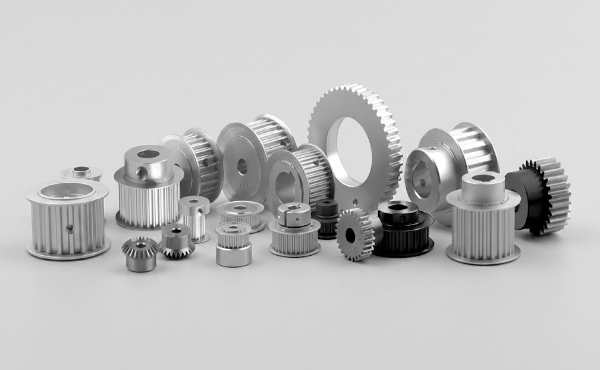
To achieve absolute synchronization between prime movers and driven loads, implementing a premium iHF timing pulley setup is the definitive engineering choice. By focusing on molecular-level manufacturing tolerances and versatile mechanical interfaces, iHF Group has engineered a robust family of drive components that transition power seamlessly from motor to mechanism, ensuring that your automation systems remain perfectly synchronized under harsh, high-duty cycles.
Perfect Tooth Mesh: The Mechanics of High-Precision Synchronous Drive
At the center of any high-performance motion system is the physical interface between the belt and the pulley. Minor inaccuracies in tooth profile geometry generate immediate backlash, belt wear, and localized tracking errors. A standard drive component often suffers from structural variance, which causes the belt to "climb" the pulley teeth under sudden acceleration or torque spikes.
The engineering behind the high-precision synchronous drive timing pulley from iHF Group directly eliminates these spatial inaccuracies. Every component undergoes strict precision machining where individual tooth contours are cut to exact microscopic standards. This extreme profile accuracy guarantees an incredibly tight, seamless belt-pulley engagement.
By eliminating the microscopic air gaps that cause backlash, the system completely prevents belt slippage and axial misalignment. For industrial applications requiring rapid reversing cycles and exact positional indexing, this perfect meshing profile ensures that rotational intent translates directly into linear or rotational accuracy without any mechanical play.
Thermodynamic Efficiency: Achieving High Efficiency and Low Noise
In high-throughput industrial environments, energy conservation and acoustic management are critical operational metrics. Conventional transmission methods like V-belts or heavy gear trains experience significant parasitic energy losses due to internal friction, heat generation, and constant mechanical drag. Furthermore, poor component meshing generates intense high-frequency vibrations, causing severe noise pollution and accelerating bearing failure.
Upgrading to an iHF low noise timing pulley system drastically alters the thermodynamic and acoustic profile of your machinery. Because of the optimized tooth geometry and smooth surface finishes, the transmission efficiency routinely exceeds 98%. This ultra-high efficiency rating means power loss through friction is almost entirely eliminated, allowing motors to operate at cooler temperatures and lower energy draw.
Simultaneously, the continuous, fluid engagement between the belt and the precision-machined teeth prevents the trapping of air pockets—the primary cause of the high-velocity whistling sound common in low-tier pulley systems. The resulting low-noise operation protects the workshop environment and reduces structural harmonic vibrations, extending the operating life of surrounding electrical and mechanical components.
Integration Versatility: Compact Design for Easy Installation
Industrial machinery layouts are increasingly constrained by tight footprint requirements. Design engineers frequently find themselves struggling to fit robust power transmission components into compact, densely integrated enclosures. Moreover, different mounting configurations across various motor shafts and gearbox outputs demand a highly flexible installation methodology.
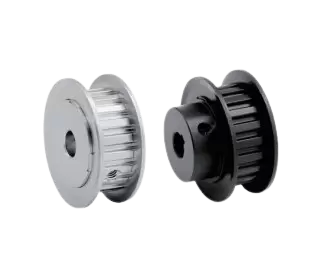
The iHF compact design timing pulley series solves these layout headaches by offering a space-saving geometry packed with versatile mounting options. Designed to reduce rotating mass and minimize overhung loads on motor bearings, these pulleys integrate effortlessly into restricted spaces.
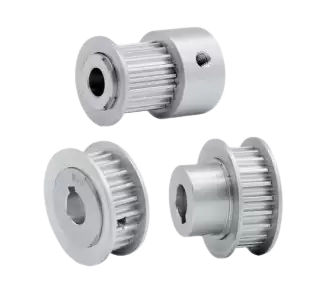
To simplify the assembly process and minimize field maintenance times, iHF Group offers multiple standardized mounting configurations tailored to specific engineering needs:
● Standard Bore and Keyway Designs: Ideal for traditional fixed-position locking on keyed shafts, providing reliable, high-torque resistance.
● Integrated Set Screws: Perfect for light-to-medium duty indexing applications requiring quick axial positioning.
● Advanced Expansion Sleeves: Designed for heavy-duty, keyless frictional locking. This system provides absolute zero-backlash shaft attachment, simplifies precise angular alignment, and allows for rapid removal without damaging the shaft surface.
视频
Protecting Production Continuity
For procurement managers and factory operators, components are an investment in overall system uptime. Choosing low-cost, unbranded timing components inevitably results in rapid belt degradation, unexpected belt-jumping, and frequent line stoppages for manual tension adjustments.
Investing in an industrial power transmission iHF timing pulley is a direct strategy for reducing the total cost of ownership (TCO) of automated assets. By maintaining perfect alignment and eliminating friction-induced wear, these premium pulleys drastically extend the lifespan of the synchronous belts themselves. The reduction in maintenance interventions, combined with the energy savings derived from a 98%-plus efficiency rating, ensures a rapid return on investment while keeping your automated manufacturing lines running smoothly, predictably, and profitably.
This website uses cookies to provide you with a safer and more personal experience. By accepting, you agree to the Cookie Policy and the use of cookies for advertising and analytics purposes.


 EN
EN en
en vi
vi it
it es
es th
th tr
tr ja
ja pt
pt ko
ko ru
ru fr
fr de
de ar
ar Request Quote