Position: Home > News Center > Industry News > How Cross Roller Slides Improve Stability, Repeatability, and Machine Performance
How Cross Roller Slides Improve Stability, Repeatability, and Machine Performance
Jun. 16, 2026 Views:144
In the realm of advanced micro-manufacturing, semiconductor inspection, and precision optical alignment, sub-micron positional repeatability is a non-negotiable operational standard. As automated component inspection structures shrink and lightwave alignment tolerances narrow, traditional linear bearing systems encounter severe performance limitations. Conventional ball-bearing linear guides, while suitable for high-speed transport, frequently suffer from localized elastic deformation and microscopic tracking errors due to the point-contact nature of ball elements. Under high structural loads or subtle moment stresses, this can result in stick-slip anomalies, geometric drift, and unacceptable path deviations.
To overcome these micro-positioning bottlenecks, precision machine designers isolate structural loads by implementing line-contact linear mechanisms. At the cutting edge of this precision revolution is the industrial implementation of the specialized Cross Roller Slide, an ultra-rigid translation stage engineered to maximize linear straightness accuracy, stabilize multi-axis orthogonal profiles, and deliver smooth movement across demanding metrology applications.
The Kinematics of Line-Contact: The Crosswise V-Groove Architecture
The exceptional tracking accuracy and structural rigidity of this stage design are directly achieved through its internal mechanical layout. The cross-roller slide employs a structure with rollers arranged crosswise on two V-groove guides. The rollers move and guide along the V-grooves, significantly improving motion accuracy and stability.
In standard linear guides, spherical balls make contact with the raceway surface at a single, tiny point. Under load, this localized pressure causes minor elastic deformation, leading to small tracking variations. In contrast, cylindrical rollers provide a continuous line of contact along the precision-ground 90-degree V-groove tracks. By alternating the orientation of each subsequent roller by 90 degrees, the internal load capacity is distributed evenly in all directions—including radial, reverse-radial, and lateral orientations.
This perpendicular crosswise configuration eliminates micro-play and internal backlash, while maximizing the contact surface area. The resulting increase in structural stiffness gives the slide an incredibly high load-bearing capability and an extremely flat linear path profile, ensuring straightness and flatness metrics within sub-micron ranges over the entire length of travel.
Actuation Profiles: Engineering Options for Specialized Feed Control
A high-precision guide system requires an equally precise drive mechanism to convert rotational input into micron-level linear steps. Depending on the speed, resolution, and load requirements of the specific application, linear positioning stages are built around three primary drive architectures:
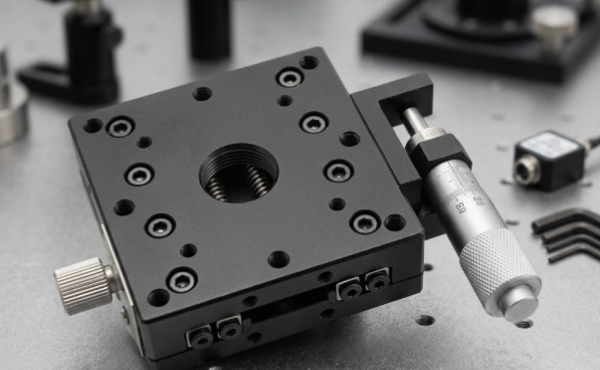
● Micrometer Head Feed: Engineered for ultra-precise manual indexing, testing labs, and laboratory research setups. This drive system relies on a fine-threaded micrometer head to provide precise sub-micron advancement increments, allowing laboratory technicians to dial in exact positions with high visual readability.
● Lead Screw Driven: Tailored for high-axial-load applications and automated integration loops. This setup utilizes a precision-ground, zero-backlash miniature lead screw or ball screw thread. This design easily converts rotary motor torque into smooth, continuous linear motion, making it ideal for high-throughput automated scanning applications.
● Micrometer Head Driven: Designed to balance rapid manual positioning adjustments with fine-tuning control. This configuration allows field operators to make quick adjustments across the stage's primary travel range, then switch to the micrometer head to lock in absolute alignment accuracy down to the micrometer scale.
Multi-Axis Orthogonal Modular Setup: Tracking Across Complex Space
Modern micro-assembly processes rarely operate along a single linear path. Complex inspection systems, laser cutting heads, and fiber-optic alignment systems require multi-axis adjustments to manage spatial alignment profiles. To meet this need, precision slides are built with multiple axial configurations, including X-axis, Y-axis, XZ-axis, and XYZ-axis layouts.
Stacking multiple translation stages together requires exceptional geometric squareness and flatness at every single mating surface. If an X-axis stage has a minor surface twist, that error is multiplied exponentially when a Z-axis bracket is mounted on top of it. Specialized cross-roller stages feature universal mounting patterns and ultra-flat precision-ground surfaces. This allows engineers to combine individual stages into rigid multi-axis setups without introducing mechanical distortion or compromising the sub-micron accuracy of the overall assembly.
Strategic Manufacturing Integration: The iHF Group Advantage
Transitioning specialized industrial equipment to ultra-precise cross-roller guidance systems requires a manufacturing partner that can balance high-volume B2B supply with strict metrology standards. iHF Group has designed an advanced line of linear translation stages that perfectly bridge the gap between high material rigidity and smooth kinematic performance.
The manufacturing plants at iHF Group use advanced multi-axis CNC surface grinding machines and strict sub-zero cryogenic stabilization treatments to ensure that every internal V-groove guide track maintains absolute geometric straightness over long production lifetimes.
The custom linear assemblies developed by iHF Group are built from high-tensile alloy steels and premium aircraft-grade aluminum. This robust design delivers exceptional thermal stability and minimal structural deflection under shifting moment loads.
By providing a comprehensive selection of stage sizes, diverse drive options (including Lead Screw Driven and Micrometer Head Feed layouts), and pre-calibrated multi-axis orthogonal configurations, iHF Group allows system integrators to drop these precision slides straight into existing optical and semiconductor setups. This seamless integration cuts down on mechanical setup times and accelerates production timelines for global equipment buyers.
视频
Comprehensive Technical Q&A
Q1: Why does a cross roller slide provide higher rigidity compared to a ball guide stage of the same envelope size?
A: The difference is rooted in the surface contact geometry. A ball guide relies on point-contact, which concentrates external forces onto a tiny area, leading to high localized elastic deformation. A cross roller guide utilizes cylindrical rollers that create line-contact across the precision-ground V-groove track. This broader contact area spreads forces evenly across a larger surface, increasing mechanical rigidity and minimizing structural deflection under heavy or shifting loads.
Q2: How does the crosswise arrangement of rollers handle multi-directional moment loads?
A: Because alternating rollers are oriented perpendicularly to each other at 45-degree and 135-degree inclines relative to the mounting base, they create a balanced internal structure. When a moment load or twisting force is applied to the stage, one set of rollers handles the compression force while the alternating set manages the lateral thrust. This evenly handles radial, reverse-radial, and lateral loads simultaneously, preventing track twisting or wobble.
Q3: What maintenance protocols are required to preserve the sub-micron accuracy of an iHF Group cross roller stage?
A: Preserving sub-micron accuracy requires keeping the V-grooves completely free of microscopic dust and particulate debris. The tracks should be wiped down periodically with isopropyl alcohol and lubricated with a low-viscosity, high-purity synthetic grease optimized for precision bearings. In high-dust environments, the stage should be protected using integrated bellows or telescopic covers to prevent contaminants from disrupting the rolling path of the internal elements.
This website uses cookies to provide you with a safer and more personal experience. By accepting, you agree to the Cookie Policy and the use of cookies for advertising and analytics purposes.


 EN
EN en
en vi
vi it
it es
es th
th tr
tr ja
ja pt
pt ko
ko ru
ru fr
fr de
de ar
ar Request Quote