In the field of modern industrial automation and advanced robotics engineering, achieving a balance between high torque density, torsional rigidity, and ultra-low backlash is a major technical challenge. As collaborative robots (cobots), high-precision surgical articulators, and autonomous mobile robots (AMRs) demand more compact profiles, traditional decoupled motor-and-gearbox setups are being replaced.
Modern design shifts lean toward highly integrated, frameless powertrain solutions. The Robot Joint Motor Gearbox: ND-R4917-10 represents a significant advancement in this specialized field, combining a permanent magnet synchronous motor (PMSM), an ultra-low backlash strain-wave reduction system, and high-resolution feedback encoders into a single compact housing.
Kinematic Integration: Decoupling the Power-to-Weight Ratio
The mechanical value of a dedicated integrated robot joint drive assembly lies in its optimized structural integration. Traditional assemblies rely on external coupling mechanisms that introduce additional mass, raise rotational inertia, and create mechanical weak points prone to fatigue.
The design architecture of the Robot Joint Motor Gearbox: ND-R4917-10 eliminates these internal couplings by mounting the reduction mechanism's wave generator directly onto the high-speed rotor shaft.
This direct integration optimizes the internal space and yields an exceptional torque-to-volume ratio. By using a frameless brushless motor with high slot-fill factor copper windings, the system provides high peak torque output while keeping the overall thermal footprint small.
This design allows robotic arms to execute high-acceleration paths without experiencing thermal degradation or mid-cycle stalling.
The Metallurgy of Backlash Mitigation and Torsional Rigidity
When managing sub-millimeter positioning tolerances in multi-axis industrial articulated arms, any mechanical backlash within the gear train causes positioning errors that compound down the kinematic chain. Selecting a premium high torque density strain wave reduction motor requires evaluating the specific metallurgical properties of the gear teeth.
The gear system inside the Robot Joint Motor Gearbox: ND-R4917-10 features custom-alloy flexsplines that undergo precise vacuum heat treatment. This process creates a specialized micro-crystalline grain structure with an extremely high fatigue limit, allowing the flexspline to handle continuous elastic deformation cycles without cracking.
The tooth profile uses an advanced S-shaped geometry that allows up to 30% of the total gear teeth to engage simultaneously. This high engagement ratio distributes internal stresses evenly, keeping angular backlash below 10-15 arc-seconds and maintaining consistent positioning accuracy throughout the operational life of the joint.

Uncompromising Reliability: The iHF Group Engineering Edge
For system integrators scaling up production of industrial cobots or heavy-payload automated guided vehicles (AGVs), component consistency across hundreds of units is essential. This level of quality control is where the precision engineering of iHF Group sets an industry benchmark.
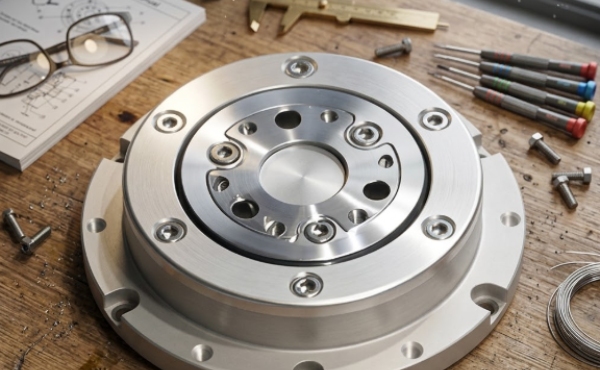
Every ND-R4917-10 robot joint module manufactured by iHF Group is built using high-precision automated CNC machining lines. This ensures tight geometric tolerances on the bearing journals and mounting faces, which helps prevent internal shaft misalignment.
The design team at iHF Group integrates robust cross-roller output bearings directly into the structural housing. These specialized bearings handle high overturning moments and external axial loads, allowing the ND-R4917-10 to function as a fully structural pivot joint without requiring secondary external support bearings.
Additionally, the dual absolute encoder setup continuously tracks both the high-speed motor input side and the low-speed gear output side. This real-time feedback loop allows controllers to automatically calculate and correct for any micro-elastic wind-up in the gear train during high-load operations.
Dynamic Thermal Control and Field Deployment Considerations
A common failure point for high-performance robot joints during continuous shifts is heat build-up within the enclosed stator assembly. If the internal temperature rises unchecked, the permanent magnets can suffer irreversible thermal demagnetization, and the internal gear lubricants can break down, leading to rapid component wear.
The ND-R4917-10 low backlash actuator unit addresses this issue with a custom aluminum-alloy housing equipped with optimized heat dissipation surfaces.
Technical Deployment Highlights:
1. Specialized Industrial Lubrication: The gear reduction system is packed with synthetic fluorinated grease that maintains its viscosity index across a wide thermal operating range from -20°C to +80°C, preventing oil leakage under continuous centrifugal stress.
2. Integrated Safety Braking: For collaborative applications, the actuator can be configured with an internal electromagnetic spring-applied power-off safety brake. This brake safely locks the joint position instantly if a sudden power loss or emergency stop occurs.
3. Advanced Bus Communication Protocols: The onboard drive electronics support high-speed EtherCAT or CANopen communication protocols, permitting sub-millisecond control loop synchronization across multi-axis robotic configurations.
Conclusion
The Robot Joint Motor Gearbox ND-R4917-10 represents far more than a mechanical transmission component—it serves as the precision motion core of today's intelligent robotic systems. Its compact design, high torque density, ultra-low backlash, and outstanding transmission efficiency make it an excellent choice for industrial robots, collaborative robots, logistics automation, CNC systems, and advanced manufacturing equipment.
Backed by precision engineering, rigorous quality control, and extensive automation expertise, iHF Group provides reliable robot joint gearbox solutions that help manufacturers achieve greater accuracy, productivity, and long-term operational performance. For companies investing in next-generation robotics, the ND-R4917-10 Robot Joint Motor Gearbox is a strategic solution designed to support the future of intelligent automation.


 EN
EN en
en vi
vi it
it es
es th
th tr
tr ja
ja pt
pt ko
ko ru
ru fr
fr de
de ar
ar Request Quote