Position: Home > News Center > Industry News > Eliminating Backlash: How Keyless Timing Pulleys Redefine Precision in High-Dynamic Automation
Eliminating Backlash: How Keyless Timing Pulleys Redefine Precision in High-Dynamic Automation
Jun. 25, 2026 Views:216
In modern, high-speed automated manufacturing, mechanical precision is the ultimate determinant of throughput quality. As industrial robotic arms, multi-axis CNC machines, and automated packaging lines push the limits of acceleration and deceleration, traditional power transmission methods reveal their inherent structural vulnerabilities. Historically, engineers relied on keyed shafts to transmit torque from motors to synchronous belts. However, under continuous reversing loads and high dynamic stress, keyways inevitably experience fretting corrosion, wallowing, and mechanical backlash.
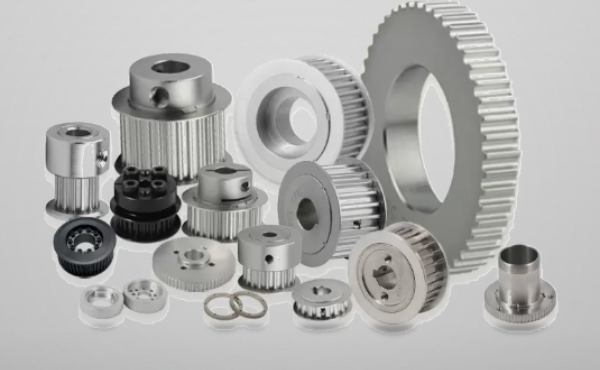
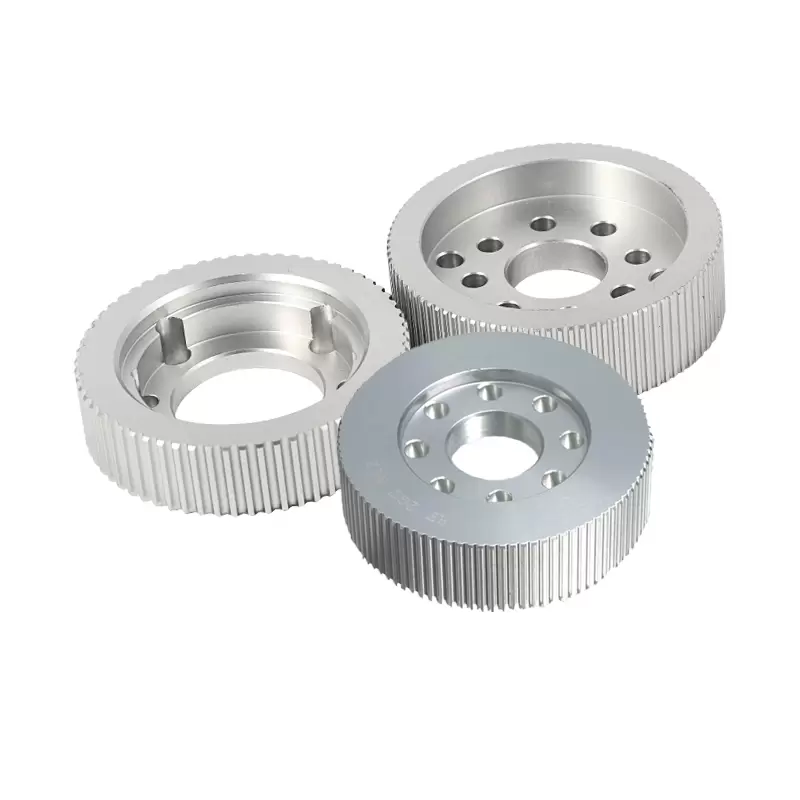
To overcome these kinematic limitations, the global automation industry has progressively shifted toward advanced integrated locking mechanisms. Deploying a high-performance iHF Keyless Transmission Belt Timing Pulley system represents a paradigm shift in motion control, offering a zero-backlash, high-torque solution that fundamentally redesigns how rotational energy is transferred across critical automation axes.
The Mechanical Physics of Keyless Surface Contact
To appreciate the superiority of a keyless synchronous drive, one must analyze the interface friction dynamics between the pulley bore and the drive shaft. Traditional keyed assemblies concentrate the entire torsional load onto a single, localized point of impact—the key itself. This unequal stress distribution induces micro-vibrations, leading to shaft fatigue and eventual failure.
A premium keyless synchronous belt pulley utilizes a mechanical taper-locking design. Whenthe integrated locking bolts are tightened to a specified torque rating, two counter-angledwedges are driven together. This action generates a uniform, 360° radial expansion force. Theresulting interference fit creates a powerful mechanical friction bond across the entire surfacearea of the shaft interface. By eliminating localized stress concentration zones entirely, thesystem allows for the transmission of significantly higher peak torques while safeguarding thephysical integrity of precision servo-motor shafts.
Zero Backlash and Spatial Phase Adjustment in Automation
For high-indexing or continuous start-stop multi-axis positioning systems, any mechanical play (backlash) within the drivetrain introduces cumulative tracking errors. This can cause severe accuracy degradation in automated picking systems or delicate print-head alignments.
Integrating an iHF Keyless Transmission Belt Timing Pulley solves this structural issue by ensuring a true zero-backlash connection. Because there is no structural clearance gap between a key and a keyway, mechanical play is completely designed out of the loop.
Furthermore, this mechanism simplifies spatial phase timing:
● Infinite Angular Positioning: Unlike keyed systems that restrict component placement topre-milled slots, a keyless configuration allows for 360° infinite rotational adjustmentduring installation.
● Streamlined Synchronous Alignment: Maintenance engineers can easily adjust the exacttiming alignment between multiple parallel shafts simply by loosening the locking screws,indexing the pulley to the exact target position, and re-torquing the assembly. Thisdrastically reduces system setup times and eliminates the cost of machining custom-indexed shafts.
Material Science and Long-Term Fatigue Resistance
Industrial environments demand hardware that can withstand high humidity, chemical washes, and continuous operational heat flux. High-performance timing pulleys are manufactured using top-tier metallurgy—typically aircraft-grade aluminum alloys (such as 7075-T6) for low-inertia robotics, or medium-carbon steels and SUS304 stainless steel for heavy-duty material handling.
By eliminating the milled keyway from the shaft design, engineers effectively prevent the "notch effect," which acts as a primary catalyst for structural stress cracks. As a leading manufacturer of advanced transmission components, iHF Group optimizes the tooth geometry and surface treatment (such as hard anodizing or black oxide coating) of every heavy duty keyless timing belt drive. This rigorous manufacturing methodology guarantees consistent tooth pitch alignment, minimizes belt wear over billions of meshing cycles, and prevents premature downtime in heavy industrial operations.
Comprehensive Industrial Application FAQ
Q: How does a keyless timing pulley handle sudden emergency stops (E-stops)?
A: Thanks to the high contact pressure generated by the internal tapered sleeves, a zero-backlash timing belt drive provides a high safety factor against slipping. During a sudden E-stop, the 360° friction bond distributes the immense inertial braking torque evenly over theshaft surface, preventing the shearing failure common in standard keyed variants.
Q: Is special tooling required to install or remove iHF Group keyless pulleys?
A: No. Installation requires only a calibrated torque wrench to ensure the locking bolts are tightened uniformly to the manufacturer's specified value. For removal, the locking collars feature integrated push-off threads; inserting the bolts into these removal holes breaks the mechanical taper bond instantly, allowing for effortless maintenance access.
Q: Can keyless timing pulleys be deployed on out-of-tolerance or damaged shafts?
A: For optimal torque transmission, shafts should meet standard industrial h8 to h11 tolerance guidelines and maintain a fine surface finish. While the radial clamping force can accommodate minor surface variations, mounting a high-torque keyless shaft locking unit onto a heavily scarred or severely undersized shaft can compromise friction coefficient calculations, potentially reducing overall torque capacity.
Q: How does iHF Group ensure precision tooth profiles across different pitches (e.g., HTD, GT3, T or AT series)?
A: iHF Group utilizes state-of-the-art CNC hobbing machines and rigorous optical inspection systems to ensure that tooth spacing conforms exactly to international synchronous standards. This precision machining minimizes chordal action (the minute rising and falling of the belt as it engages the pulley), ensuring extremely quiet operation and exceptionally stable linear positioning profiles.
This website uses cookies to provide you with a safer and more personal experience. By accepting, you agree to the Cookie Policy and the use of cookies for advertising and analytics purposes.


 EN
EN en
en vi
vi it
it es
es th
th tr
tr ja
ja pt
pt ko
ko ru
ru fr
fr de
de ar
ar Request Quote